Friday, 3 March 2017

Quaker Work and Quaker Play

This is Tim Herrick's 'Inner Quest' talk at Sheffield Central Meeting in January.

My themes today are Quaker work, and Quaker play; and the personal examples I will explore are my paid employment at the University, and my family life with Jayne and Isaac.  These are both areas of work - teaching as paid work, and the effort that goes into constructing a functional, let alone happy, family life - and play - doing fun things with lively people, whether in the walls of the University or at home.  I present them here as examples of playing and working, and want to explore how my Quaker identity - the things I try to be, do, and say - underpins them both.  They may not speak to you as examples, which is entirely fine; and I hope here to start a conversation about work and play where your own stories can be told.

One reason for thinking about working and playing in a Quaker way is that in both of the main activities of my life - teaching, and being a husband and father - I am frequently required to improvise.  Neither area is definite, fixed, or certain; a student’s question might take a class off in an entirely different direction; Isaac might decide today is the day he wants to jump in puddles rather than walk to the cornershop.  I need to be able to respond no matter what, and address the emerging needs of others as well as myself. In the necessary absence of definite things to do next, it’s useful to have a bigger sense of what I would like to happen - the shape of an outcome, not a clear picture.  So as a parent and a teacher I am regularly confronted by new situations where I don’t know what to do, and my Quaker faith and practice helps in several ways.  Firstly, it reminds me that I’m not alone in carrying my troubles, nor am I the first to feel lost among life’s way.  Secondly, it offers a still point of deeper belief by which to orientate myself.  Thirdly, it offers wisdom, experience, and a sense of loving care.  And lastly, for me, it encourages playfulness and experimentation - those two words, “Live adventurously”, resonated deep within me when I first came into contact with Quakers.  So even when hard at work, I try to retain a light sense of playfulness; and when playing, an awareness of the heavier burdens that play might be carrying.

As a Quaker and a teacher, there is a rich point of inspiration in the work, thought, and writing of Parker Palmer.  His book, The Courage to Teach, is one of my favourite about the slippery business of learning and teaching, and I am lucky enough to be in a position to recommend it to others.  In this book, he talks about teachers reconnecting with their heart, the emotional drive to make the world even a tiny degree better, that is likely to have pulled them into teaching in the first place.  He also emphasises the importance of wholeness in a teacher’s life - sustained by community, and interactions with loved ones, but ultimately, a version of yourself that is the same showboating in front of 200 students on Thursday afternoon, as it is sitting silently in Meeting on Sunday morning.  The integrity developed here - and reinforced above all by the discipline of a Meeting for Worship - comes across to learners, and enables them to feel supported and secure in turn.  It also helps with the vision of teaching to which I hold, the primary component of which being listening; listening to the learners, to the materials that we share, and to myself seeking a deep sense of what feels right.  The integrity that Parker Palmer emphasises holds me still in this act of careful, tender listening; my heart an anchor keeping me tethered to the needs of others.

My work, and the work of any teacher, is also grounded in hope: a belief that people can and will change, and become better through engagement with the world outside their heads.  A passage from Quaker Faith and Practice pinned in my office reads:

To pray about any day’s work does not mean to ask success in it. It means, first to realise my own inability to do even a familiar job, as it truly should be done, unless I am in touch with eternity, unless I do it ‘unto God’, unless I have the Father with me. It means to see ‘my’ work as part of a whole, to see ‘myself’ as not mattering much, but my faith, the energy, will and striving, which I put into the work, as mattering a great deal. My faith is the point in me at which God comes into my work; through faith the work is given dignity and value. And if, through some weakness of mine, or fault of others, or just ‘unavoidable circumstances’, the work seems a failure, yet prayer is not wasted when it is unanswered, any more than love is wasted when it is unreturned.
(QFP, 20.08)

This passage speaks to me because of the balance it finds: my work, and my self, do not matter much by themselves, but the things I put into the work, and the energy that I channel through it, matter a great deal.  This, for me, encapsulates something critical about the work of teaching, which is using yourself as a bridge to enable the understanding of others.  If it’s only you as the bridge, then within no time it will be fractured and adrift.  But if it’s you, and your faith, and the spirit that moves through the Meeting - then it can withstand almost any amount of pressure.  Instead of a rigid iron bridge, it becomes something light and, flexible, responsive to the dance of the wind and the pressures of travelling feet.  This not only helps it last for much longer, it also makes it a more pleasurable experience to travel over; and, just as trying to present your wholeness and integrity can help learners find their own still small voice, it can demonstrate that to enable others to learn, all you need is a little flexibility.

The other area I am exploring in this talk is family life, and the pleasures and perils this offers.  I feel I can do this here, in the room where Jayne and I were married and where Isaac first visited when he was six days old, amongst friends, with large and small Fs alike.  One of the many delights of spending time with Isaac is the development of little games and activities where we each have certain parts to play and variation, within strict limits, is encouraged.  The term that fits them best is “routines” - following the poet Lawrence Ferlinghetti, this seeks to capture both their rule-bound nature, and their comedic intent.  An example may help.  After bath, either Jayne and I will sit with a towel-wrapped Isaac, and play “The clapping game”.  This is essentially a game of imitation with Isaac leading - clapping might have been the initial action, but now, when he puffs out his cheeks, we puff out ours; if he shakes his head from side to side, we follow suit; and if, as he is wont, he shouts “PIRATES!”, then we are obliged to do the same.  The core intent, it seems to me, of the clapping game and related routines, is for Isaac to be sure that we are listening to him and responding in ways that he appreciates.  Quaker Faith and Practice 22.62 might help us take this further:

There is little question that if as a parent we have not taken the time really to listen to children when they are young, listened not only to their words but to their feelings behind the words, they are unlikely to want to come with their sharings in later life.

Sometimes, Isaac is so keen on us listening, he will compel us - placing his favourite snuggly, Baa Lamb, over mine or Jayne’s mouth, he will repeatedly ask “Can you talk?”  The appropriate response here is a combination of expressive eyebrow movements and “Mmm mmm”, until Isaac chooses to remove the gag and carry on with a two-way conversation.  But most other times he is very happy to listen to us, and us to him, without the need for compulsion.  He will recite and act convoluted stories that put the myths of Babylon to shame, as the dolls from his dolls house fly to the moon, get trapped in a tunnel, or go for days out (with plenty of telling each other to “hurry up”).  Listening to these is a pure pleasure as we enter into his imaginative world, laying aside adult cares and taking time to be still.  As the passage quoted earlier from Quaker Faith and Practice goes on, “Learning to listen to each other in families can help to make us better listeners to others and to the Inner Guide”.

Another routine Isaac has developed is called “Scary monsters”, and it comes from a dark place.  It was developed after two very raw arguments between Isaac and I, when hurt, frustration, and anger were what we shared as we were locked in combat.  The details of these arguments matter so little I can’t recall them; but they both pulled hard at the threads of our love, and I am (amongst other things) enormously proud of Isaac for having the resilience to find his own way to handle conflict.  “Scary monsters” involves putting your face very close to your partner’s, almost nose to nose; and shouting, loudly, and at length.  Turns are taken, at least initially, and it ends with a hug, or a wrestle that is also a hug.  A passage from Quaker Faith and Practice perhaps helps explain “Scary monsters”, and the work that Isaac has realised it does.  The passage reads:

I have heard some Friends deny their anger in a silent ‘peace’ where there is no understanding of each other. Such Friends are angry but by their silence the progress of world peace has stood still. If we are angry we know how wars develop. It does not matter who’s wrong. What matters is that we care enough to talk to each other.

How do we become reconciled to each other if we are asunder? All I can say is to go up to that person and say what is in your heart; that their ways are hurting but you still love them. But this takes time and not many people like to look in a person’s face and find out who they are. So we miss the reconciliation and do not have the experience – that we cared. Given that, then we will know who we are and find relief in tears we all should share. This is where peace starts.
(QFP 20.68)

As a family, we do many things.  We argue, and we care.  We make each other laugh, and we make each other cry.  We play, and we work with, on, and for each other.  An image I sometimes have in mind is Jayne, Isaac, and I as enmeshed cogs within a machine, each of us supporting each other by turns; but also sometimes catching on each other, and wearing each other away.  The outcome is that we fit together very well, but perhaps slightly less well with other people, other parts of the machine.  This is one reason why Meeting is so important; it offers surrounding parts that support and work with what we’re doing, while also offering differences and things that we can imitate. Within the larger family of the Meeting, our little family can be grown with love, as we continue to work and play together.

     How does your Quaker identity come out in the work you do for love, and/or the work you do for pay?
     Where, for you, does playfulness meet Quaker-ness?


In the discussion that followed, the ideas outlined here were given much more richness and depth by the contributions of others.  The point was beautifully made that as adults, we all have experiences of being children, and these experiences will be shaped by our families and other immediate influences.  Our memories and experiences are not all going to be happy, which means that there are likely to be hurts we are carrying around; these may come out when confronted with other people’s, including children’s, hurts.  We also discussed how adults have forms of play - routines of their own - which give them opportunities for creativity and joy, from sport to drama and the wonderful-sounding “silliness therapy”.  Lastly, there was a good discussion of some of the differences between parenting and grandparenting - which could perhaps provide the starting-point for another Inner Quest in future.

Tim Herrick

Wednesday, 28 December 2016

Thoughts for 2017

In January 1932, the Quaker philosopher John Macmurray broadcast a series of talks on the BBC. What would become known as the Great Depression was biting hard and unemployment and poverty were on the rise, whilst in Europe Mussolini was in power in Italy and Adolf Hitler would grab power in Germany in the next few months.

Transcripts of these talks and earlier broadcast talks were later published as 'Freedom In The Modern World'.


This is how he concluded his final talk:


John Macmurray
Why can we not act greatly for the solution of our international economic problems? Why do we simply watch our social system going to pieces before our eyes? Why are we paralysed? Because we are afraid, afraid of one another, afraid of ourselves, afraid of the consequences of any decisive action. We are fear-determined, and our one demand is the fear-demand, the demand for security, for protection. Our dilemma lies in the fact that the more we try to defend ourselves the more we destroy ourselves by isolating our selves more and more from one another. You have noticed, have you not, that our efforts to solve a confessedly international problem only seem to increase nationalism? That is because it is fear that is the motive force of our efforts to solve the problem. There is only one way in which we can escape from the dilemma, and that is by destroying the fear that is at the root of it.
...
I do not think that Christianity will save us from the things we are afraid of. I think it would save us from the fear of them which paralyses us. … Real Christianity stands to-day, as it has always stood, for life against death, for spontaneity against formalism, for the spirit of adventure against the spirit of security, for faith against fear, for the living colourful multiplicity of difference against the monotony of the mechanical, whether it be the mechanization of the mind, which is dogmatism, or the mechanization of the emotions, which is conformity.
...
What are we to do about it? ... how does one begin to grow faith? How does one set about developing freedom of feeling, and rid oneself of fear? … It is you and I who are afraid, … Whatever we do will be wrong till we are put right. If we start trying to set our feelings free we will just be making the dilemma worse; because we shall use our intellects to force ourselves to feel and to act from feeling, and the whole action will be a sham. It would only express what we think we feel, or what we think we ought to feel; and our last state would be worse than the first. We should turn our fear of feeling into a fear of not feeling, our fear of spontaneity into a fear of not being spontaneous. Reverse your fear, change its object, and it is still fear. We are in a vicious circle. Until we are healed we cannot act healthily.
...
What we have to do is to wait and be quiet; to stop our feverish efforts to do something; to cease our fruitless attempt to save ourselves. Salvation, if it comes to us, must come from outside. We must wait for the new thing to be born in us; for the new light to be manifested to us. Even to look is useless, for our eyes are blinded. We can only be quiet and wait, expectant but unworried, for the creative word that will say, ‘Let there be light.’ There is nothing else to be done. The next word is not with us, but with reality.
'Be quiet, be still–the world is not resting on our shoulders; if it were, heaven help it! If we are so futile and stupid, why should we be saved? And if our civilization is sham, what point is there in its preservation? Drop this stupid struggle against the reality of things; there cannot be anything real to be afraid of.’ For we all know by this time that what we want is a new and better social order, which will be built and enjoyed by better men and women than we are; and obviously, if we are to have a new world we must let the old one go. Even if it is like death to turn our backs upon it, to stand still and see all our defences crumble and our security vanish like smoke, … that ‘he that loseth his life shall keep it’. It is possible for [persons] and for societies of [persons] to be reborn, even if it is impossible to have them reconstructed.

Wednesday, 19 October 2016

Our Spiritual Review

As a Meeting, we discerned in June 2016 that it was the right time to embark as a whole meeting on a review of our experience of our Meetings for Worship; we want to listen deeply to one another and enrich our lives as a worshipping community.

We hope that all the many and different existing groups and committees will make a space to reflect together. And there will be lots of other opportunities to meet individually or in different groups to deepen our spiritual lives together; for more details, please look on the review noticeboard or ask an overseer.

Questions to use to talk, listen and reflect….
What is my experience of meeting for worship? 
What do we value in our meetings for worship? 
Sometimes I feel helped by meeting for worship and sometimes I don’t. What makes the difference? 
What (one thing) would make a really helpful difference to my experience of meeting for worship? 
What keeps me coming to meeting for worship and what prevents me?
We suggest, whenever and however Friends are meeting to reflect together, that we all…

Spend time together in silent worship.

Take unhurried time to reflect together using the questions/ conversation starters above.

Write a minute or find another way of sharing your responses to these questions….a painting? a poem? a blog post? There will be a noticeboard and table in the social space for this purpose and/or you can email spiritualreview.sc@sheffieldquakers.org.uk

We will be exploring creative ways of ensuring we can share together as much as possible.

It would also be helpful to have a list where possible of the names of those who have met so we can ensure as many Friends as possible are included.

The Spiritual Review planning group, on behalf of Sheffield Central Local Quaker Meeting

Friday, 7 October 2016

Just Sit

Just sit there right now
Don't do a thing
Just rest.
For your separation from God,
From love,
Is the hardest work
In this world.

-Hafiz

Friday, 13 May 2016

Spring Haiku


Despite everything

the leaves come out. The Spring still

won't give up on us.


Wednesday, 27 April 2016

Divesting from fossil fuels? Inspiring returns from community renewable energy

Quakers have been a lead in divesting from fossil fuels. Here is my personal story.

As the pressure is on to be open and transparent about our investments and tax returns, I am coming clean that I decided to invest my modest NHS pension pot, not in an off shore unit trust, but in renewables, run by cooperatives. One of which is Four Winds Energy Coop.
http://www.fourwinds.coop/home.asp

If you don’t want to read any further I highly recommend the video on their website  “how coal country can spark a clean energy revolution.”https://vimeo.com/121124286

I attended the Four winds energy coop  AGM on the 19th March in Barnsley which included a site visit to their 500kw turbine on a disused colliery site at Shafton. The coop have two 500kw turbines up and running on old colliery sites. The Shafton turbine pictured here which started generating in July 2015, and the other one at Duckmarton, near Chesterfield, which started generating in December 2014.
 
Close to, the turbine seems vast. The shaft is 70 meters tall. All we could hear was a gentle purr. We were shown inside by the members of the board who were very experienced retired people, who had been working in a voluntary capacity for several years to get this to happen. One, a retired electrical engineer, told us the turbine was bought and imported from the Netherlands. He told us at the beginning of his working life there were 6 factories in the UK manufacturing turbines, now there are none. The picture on the right is the computer control screen from inside the turbine.  It was really impressive to see how the blades alter their pitch and direction in response to wind speed and direction. The turbine has been generating electricity for nine months and generated one million kw hours, roughly enough electricity for 500 households. Looking 360 degrees from the turbine we could see the communities of Grimesthorpe, Cudworth and Shafton...in our  view about 500 houses.  However, in the UK you can’t sell electricity directly to your local community, like you can in Germany, so this electricity is sold to the grid with remuneration through the Feed in Tariff(FITs). Instead the agm decided that in future years 5% of any dividend should go to a community fund and if possible, one that addresses fuel poverty. The Duckmanton turbine started generating in December 2014 and they have a community fund up and running, working with the local primary school who want to fit solar panels on their roof.

The AGM itself was both inspiring and depressing. The accounts indicated the coop paid for the secretariat services of the parent energy renewable coop, Energy 4 All, which amounted to one part time job and salary. The directors received no fees, just modest travel expenses. (Rather different from any bank or building society!)The deeply depressing information was that the coop had plans for 6 further turbines all on disused colliery sites in Yorkshire, but these are no longer viable due to the governments changes in policy..viz:making planning permission much harder, massively reducing the FITs, and  stopping tax incentives for investing in renewables.

I think this example of Four Winds coop shows what can be done, and at the same time exposes the total hypocrisy and deceit of our government. David Cameron signed the climate Change agreement in Paris last December to commit to massively reducing our fossil fuel emissions and build up our renewables, and also declares he wants to encourage local enterprise and initiatives.  With policies that cramp initiatives such as the Four Winds coop what is going on? Can we hold him to account?

But above all I am filled with gratitude for those men and women who put their all into making these turbines whirr.

If anyone is interested to look into investment in community renewables I can recommend
Triados renewables, now called Thrive renewables. https://www.triodosrenewables.co.uk/en/home/
and Energy 4 All    http://energy4all.co.uk/


Heather Hunt
11th April 2016

Monday, 25 January 2016

Noisy Silence

Recently I attended, for the second time, the Sunday service of a Sheffield Apostolic Church that has emerged from within the Slovakian Roma community. It has been brought from Slovakia and holds services on Sunday afternoons in Sheffield. It takes place entirely in Romany. The service lasts over 2 1/2 hours and is made up of quite a long period of singing followed by a long and impassioned sermon and then some more songs and ending with a prayer. I was the only non-Roma person in attendance and I stayed towards the back of the congregation (about a hundred adults and twenty or thirty children).

What struck me was the facility we have for finding silence and space for contemplation amongst noise. I sat there at the back and I suppose for a time the service became a sort of white noise within which I bore witness briefly and silently to the Quaker tradition.

Thursday, 7 January 2016

Spiritual Journey

'Spiritual Journey' is, it seems, used by everyone of a religious or spiritual persuasion. But what does it mean? There is no actual physical journey, so it must be a metaphor. Unfortunately, like all metaphors, it can be misunderstood or misused. For me, the most problematic misuse of the metaphor 'journey' is to think of it like an actual journey to a different place or possible 'state', that is, as some sort of progress or growth.

The problem with thinking of one's 'spiritual journey' like a real journey is that in fact spiritually we do not 'progress' or 'grow' in the normal sense of these words. This is dangerous because the whole mindset or paradigm of western civilisation in which we find  ourselves is about progress and growth, so it is rather too easy to slip into the same understanding with spirituality. Thinking in terms of progress and growth is of course disastrous in the context of 'economic growth'  since we live on a finite planet, bit also in terms of technological progress because we come to put faith in a future where technology will fix – or at least ameliorate – our problems.

Spirituality does not 'progress' and 'grow' – the best perhaps we can say is that it deepens. However, a mere child can have a deeper spiritual awareness than the oldest person with a lifetime of spiritual practice, such that the child knows that the emperor has no clothes and so bursts the bubble of our hubris. Spiritual insight or depth comes by grace, and all we can do is make ourselves more receptive.


It does not help that in the Christian tradition there is the concept that that the world and our body in it are 'bad' and that we will one day be in heaven, which is 'good'. This just encourages the idea of being on a journey to another place. Jesus himself talks about the 'kingdom of heaven' being  amongst us, so this idea of denying the world is surely false. If the 'kingdom of heaven' is amongst us, where then do we journey to?

However, traditional mythology is replete with the metaphor of the journey or quest, usually undertaken by the young man [is it invariably a man because of patriarchy, or because women see the world differently?] in order to find themselves.  But in stories, the hero's journey always takes them back to where they started. Odysseus returns to Ithaca and Bilbo goes 'There and Back Again' and Dorothy goes back to Kansas.
“We shall not cease from exploration
And the end of all our exploring
Will be to arrive where we started
And know the place for the first time.”
(T.S. Eliot, Four Quartets, Little Gidding, V)

The purpose of the spiritual 'journey' then is to come to know ourselves in the time and place and community in which we find ourselves – to come to know time and place and community 'for the first time' and so become situated persons. It is not by 'progress' and 'growth' that we become situated, but by 'care' and 'attention' – care for one another and the environment around us, and attention to the time and place and culture we are in.
Like Dorothy we have to realise that 'there’s no place like home'.

Wednesday, 2 December 2015

'Reading Quaker faith & practice' conference at Woodbrooke

All area meetings in Britain have been invited to nominate a Friend to participate in the 'Reading Quaker faith & practice' conference at Woodbrooke, from 22nd to 24th April 2016.

The conference will provide an opportunity to:

Learn from one another’s experience of participating in the Reading Quaker faith & practice programme so far.

Gain ideas and resources for setting up and inspiring groups in meetings.
Share reflections and insights emerging from existing groups.
Understand more about the origins, purposes and development of the current book.

The conference welcomes participants from all area meetings, including those which have not yet decided to participate in the Reading Quaker faith & practice project.

Area meetings are being asked to nominate a Friend or attender who has one or more of these qualities:
  • is involved in an existing Reading Quaker faith & practice group 
  • is willing to promote the programme around the area meeting 
  • has a concern for spiritual learning in the area 
  • will be able to communicate with others about what they have learned
If you would be interested in attending the conference on behalf of your area meeting, please talk to your AM clerk or nominations committee. For more information about the conference contact: qfp@quaker.org.uk

Wednesday, 30 September 2015

Killing machines R us. Protest at DSEI arms fair.

photo CAAT

photo CAAT
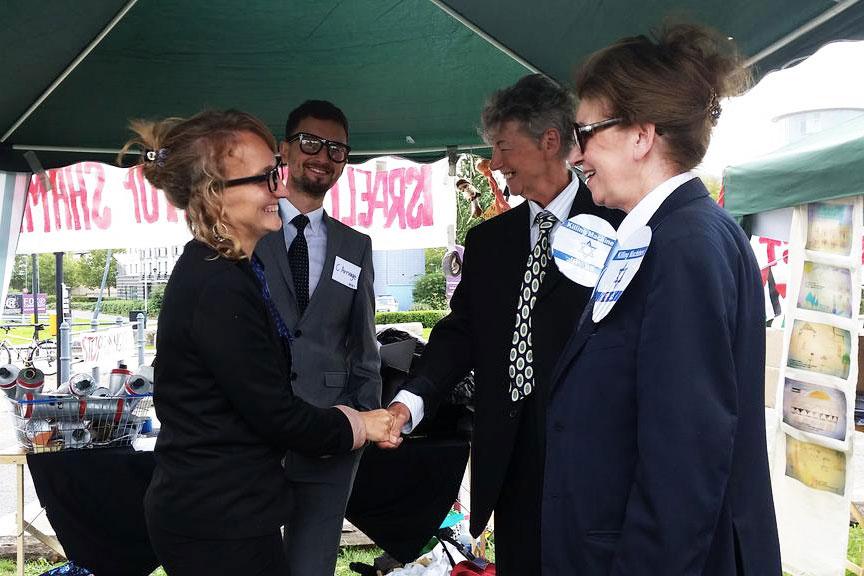
Heather Hunt , attender at Sheffield Central meeting,  donned a corporate suit and posed as an Israeli arms dealer on the first day of action to stop the London based arms fair on Monday September 7th.  This day was to highlight and protest about the Israel and UK two way arms trade .

Heather is part of Sheffield Creative Action for Peace  (SCRAP) and talks about her motivation and the day of  action.

Israeli-UK two way arms trade. BDS campaign
“I was shocked that the UK government had invited Israel arms dealers to have a pavilion inside the DSEI arms fair to be held at the Excel centre East London. I am proud that the Quakers are active in opposing arms sales to Israel. However, I hadn’t realised how complicit the UK and Israeli governments are in this mutual support of arms dealing as good business.

So I was delighted to be part of Sheffield Creative Action for Peace (SCRAP) and its contribution to the protest to highlight and oppose this two way arms trade. Two of us posed as Israeli arms dealers with our badges, “killing machines are us” with client support sheets detailing how you can get more for your bucks with our combat tested weapons.   (eg Friendly and uncritical allies like the UK and US.) We displayed our products to interested independent media from our portfolio of 2D replicas which included our biggest sellers:
Elbit Hermes 450 drones, made in the Israeli owned Elbit factories in the UK  and used extensively on the Gaza strip.  Our sales pitch, backed by research, included “Can be fitted with two hellfire missiles. Recent sales include Columbia, Indonesia and Sri Lanka.
And
Merkava tanks
Manufactured by Israeli military Industries and assembled by Israeli Ordnance corps. Fitted
with 2 machine guns which can shoot down helicopters. Field tested on Gaza.  One tank killed 120 Hammas militants in Protective Edge. Sales increased after assault on Gaza.  “Very serviceable. Main battle tank for many countries. Selling well. Now upgraded to include night sensors and target trackers and adapted for guerrilla warfare.”

Honouring Palestinians killed by Israeli drones
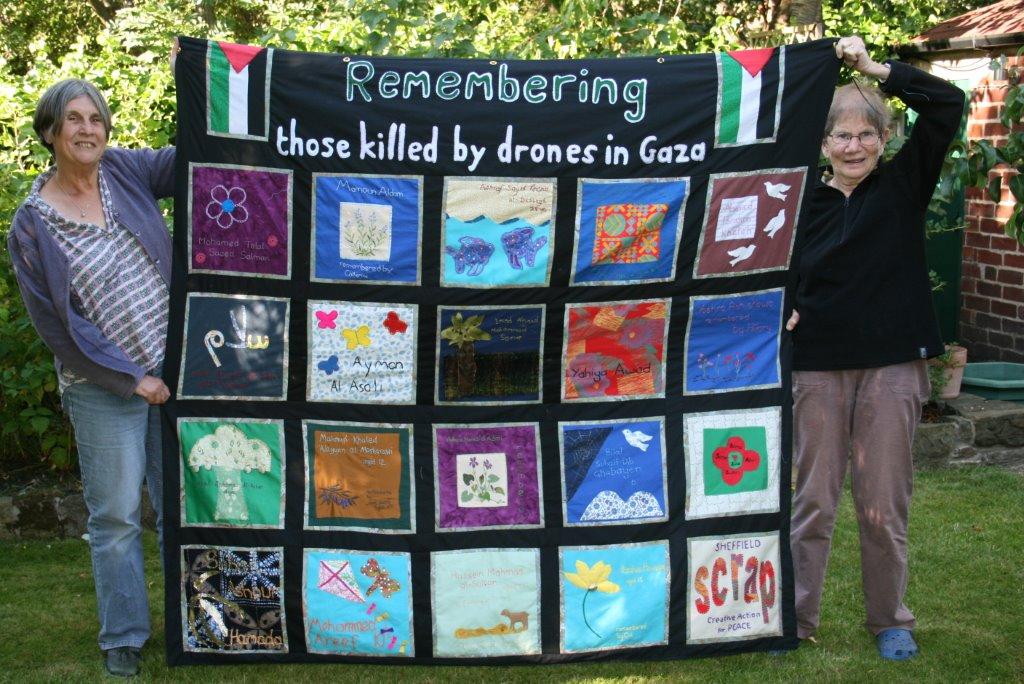
To highlight the nature of Israeli weapons other members of SCRAP displayed the Drones quilt we have been making, highlighting and naming Palestinians killed by drone strikes on Gaza.

photo SCRAP
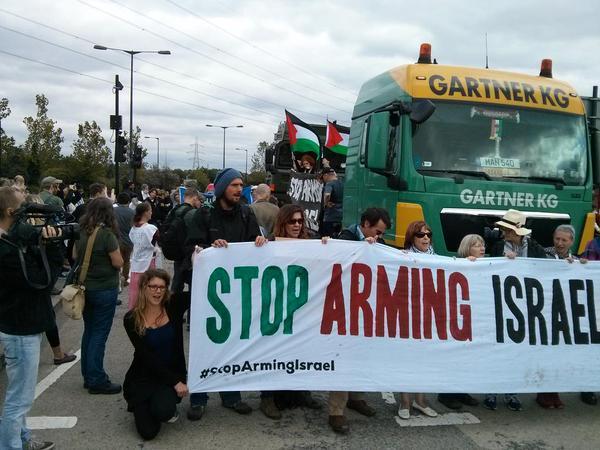
During the day an enormous low loader arrived conveying a military vehicle looking like a missile launcher. Protestors immediately got onto the road and between us we stopped the vehicle going into the Arms fair for two hours.  3 women clambered onto the vehicle and, with a Palestinian flag flying, read out testimonies from families whose children were killed in the 2009 Israeli massacres in Gaza. And then, with the lorry still blockaded and the road therefore closed, we held a dabke dance workshop in front of the lorry, on the road with police dancing round our circle trying to give us an arrest warning.

photo CAAT
War is good for business and economic growth.
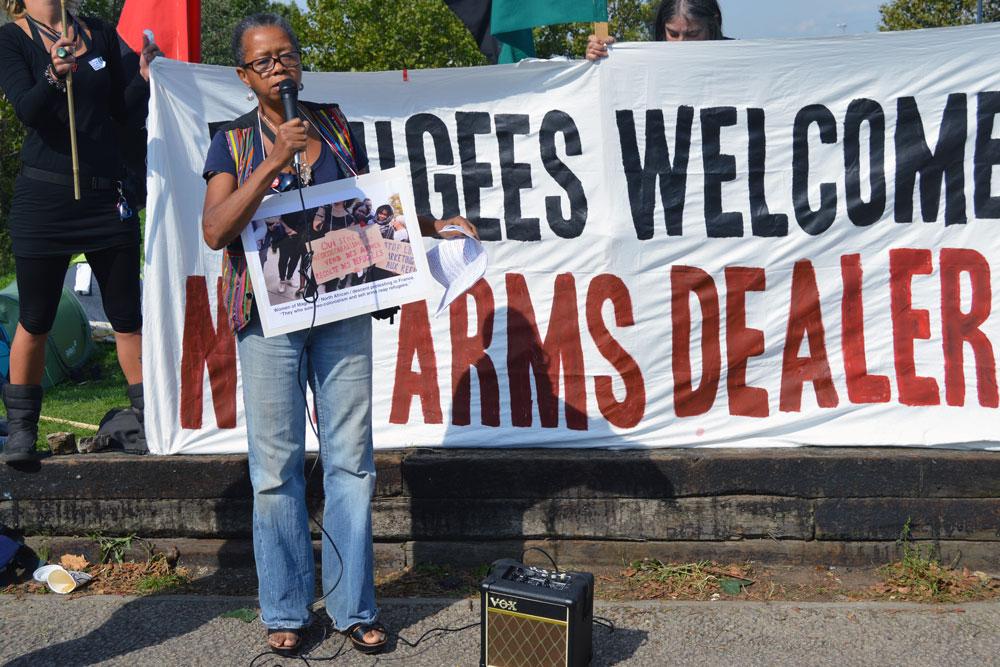
Refugees not arms welcome here.

We found out that the drivers of the low loader we stopped were Hungarian and had driven this vehicle from Southern Hungary, through Austria and western Europe. Sometime over the weekend the driver probably drove past the thousands of migrants walking to Vienna, most of them from Syria and Afghanistan, fleeing wars prosecuted and fed by the sort of materiel he was carrying. 

How ironic is this? That killing machines can cross European borders easily whist humans fleeing war torn countries cannot. The stark realisation before us then was seeing how war is so good for business. Weapons used by all and any side in Syria and other conflict torn countries around the world continue to get circulated and traded, making profit for some and for others, their lives are ravaged.

The day was an excellent example of effective collaboration between CAAT, War on Want, and Palestine Solidarity campaign.  It gave me hope we can work together and creatively to advocate for humane and just settlement for refugees, and an end to the arms trade.

Reflections
I enjoyed researching my role as a corporate Israeli arms dealer and keeping in that role for 5 hours. I gained an insight of a little of what it could be to be in that person’s shiny shoes. I was marketing manager and my colleague was client support. As we approached the protest, we were shouted at “shame on you! Murderers!” Some protestors really were taken in by us. We arrived confident and smart. From this vantage point the protestors looked SO scruffy and not worth listening to.
Later in the day during one interview, with Russia today, I was asked if I felt guilty and responsible for so much killing and death.  I surprised myself (in role) by the question-not understanding the feeling or the question. Of course we were serving our country, particularly keeping our economy afloat.  Guilt? What has that got to do with it.
Heather Hunt 23rd September 2015

You can see films of the action here and here.

‘Testimonials From Families of Palestinian Victims - #OccupyDSEI Day One’

SCRAP meets on alternate Thursday afternoons. Next action October 3rd, Waddingtom RAF base. Scones not drones.

Saturday, 19 September 2015

Our faith in the future

Quakers in Britain have a new 'long term framework' to guide our discernment at all levels of decision-making, including our local and area meetings, as well as our centrally managed work. The document, called 'Our faith in the future', was approved by Meeting for Sufferings (our national representative body) on 5th September. It replaces the 'Framework for Action 2009-14', which was a previous attempt at a 'strategic framework' for Quaker decision-making.

The new document has shifted the focus away from a list of priority areas of work, and towards a vision of the kind of Quaker community we aim to become. No strategic plan or framework can dictate how the Spirit may lead individual Friends, local meetings and the wider Quaker community in the future. Our way of corporate discernment is based on the faith that God's guidance is available to us in community, with the authority to upset all of our cherished plans.

For this reason, the group appointed to write the new long term framework has wisely avoided any attempt to prescribe what kind of work Quaker communities should undertake. Instead, the document directs our attention towards some of the core principles - of spiritual rootedness, inclusion, discipline and social engagement that are at the heart of our Quaker practice.

Hopefully, the text will act as a reminder of what we already know by experience to be important, supporting our practice of Spirit-led discernment rather than imposing pre-determined outcomes on it. The full text is given below:

Our faith in the future

Facing turbulent times, Quakers in Britain seek a future where…

Meeting for worship is the bedrock of living as a Quaker. In worship we become one with the Spirit, with each other and with our true selves. The Spirit is the source of strength and guidance for all we are and do. Our way of worship is open to all, and we are making it available to more people.

Quaker communities are loving, inclusive and all-age. All are heard, valued and supported both in our needs and our leadings. Everyone’s contribution is accepted according to their gifts and resources. All ages and conditions are welcomed and included. There are clear and effective ways of working together on shared concerns. Fellowship and fun strengthen the bonds between us, enhancing a loving community.

All Friends understand and live by Quaker discipline. Our discipline is actually 'letting go and letting God': not thou shalt nor I will but what does Love require of me? It works when we understand it and practise it! Because we understand it, we can share it with others. Our testimony guides us, but we have to work on what it means for each of us personally.

Quaker values are active in the world. Our lives speak peace, equality, respect for the earth and all its inhabitants. We offer friendship to all and solidarity to the marginalised. We speak truth to power with love. We hold those in power in the Light. We find creative and nonviolent ways to get our message across. We are in for the long haul; we’re not afraid to take risks. We are called to live in the place where our deep gladness meets the deep hunger in the world.

Quakers work collaboratively. We are well aware that we can't put the world to rights all by ourselves. We value the important work of others; by engaging with them we are already changing the world. We want to break down barriers; we refuse to prejudge who is or is not an ally.

Quakers are well known and widely understood. We are active in our local communities, reaching out in friendship, making more use of our meeting houses for events and renting/lending out. All members are ready and equipped to explain our way confidently and clearly to anyone who asks, as well as to speak publicly on issues of concern. We share our practices where appropriate and make full use of new media to reach out widely. In an increasingly divided world, we try to offer 'patterns and examples' of a caring community.

… a future where we let our lives speak

Friday, 29 May 2015

'Right to Roam' for Palestine

I have just come back from a 7 day, 90 mile, (144 km) walk across Scotland, joining Caroline Poland for a stretch of her Right to Roam, End to End walk for Palestine, raising funds for projects in Gaza. I’ve pasted her leaflet below. Here is a little inspiration and a  humble invitation for retrospective sponsorship.

Four of us set off from Peebles on May 13th, walked over the Pentland hills to Edinburgh and then mostly via the tow paths alongside the Union and Forth and Clyde canals, to Milgarvie, just North of Glasgow. We walked about 13 miles a day, often against strong head winds. I’ve calculated that is 184,320 foot steps. Memorable sights along the way were the long vistas from the Pentland hills, aqueducts on the canal, awe inspiring Kelpies and the superb engineering of the Falkirk wheel. So thanks you walking companions, our friendly hosts, and feet, legs and boots!

It was a very good time to be in Scotland, after the election, meeting friendly people delighted they were part of a society that had said NO to austerity and the Tories. Carrying a Palestinian flag, with WALK FOR GAZA inscribed, we did not meet any opposition but rather we were  met with interest and admiration for Caroline’s End to End walk and support for the projects in Gaza.

Two highlights for me are firstly a taxi driver in Falkirk (honest—at the end of a long walk day, only way to get to see the Kelpies.) On hearing what our walk was for he said, “don’t pay me the fare (£5), put it towards the projects in Gaza”

My second highlight is learning about the Shministim, Israeli school leavers refusing conscription to join the Israeli army. We learnt about them through a friend in Protest in Harmony who hosted an evening Palestine solidarity event in Edinburgh for and with us. I’ve pasted their collective letter to  Binyamin Netanyahu at the end of this email.

I may be a bit foot sore but it’s been a very heart warming experience. As a fellow traveller suggests, the Right to Roam walk brings out a strong connection to our common humanity.

 
If you would like to sponsor the walk and support education for women in Gaza   you can do so via
‘Sheffield Palestine Women’s Scholarship Fund’:

many thanks

Heather Hunt

‘RIGHT TO ROAM’ / ‘END TO END’ WALK FOR PALESTINE
Raising funds for projects in Gaza

In Britain, as in many other countries, people have had to struggle for the Right to Roam, the right to walk, to wander across the land. We started out on our Right to Roam walk in May 2013, following the 268 miles of the Pennine Way from Edale, over Kinder Scout, the site of the historic Kinder Trespass, to Kirk Yethom just over the Scottish borders.  We continued our walk last year, walking from Land’s End to Bristol, and then later in the year, from Bristol to Edale to complete the ‘England’ stage of our walk. Right to Roam / End2End walk for Palestine last year, walking from Land’s End to Bristol, & then Bristol to Edale, to complete the ‘England’ section of our walk.  The walk so far has covered around 800 miles – a stark contrast to harsh severe restrictions of movement for all Palestinians to, from and within Palestine, and in particular the harsh restrictions, attacks and siege of 1.8 m people within the narrow 26 mile Gaza Strip.
We are now on the first of the two stages of our Scottish section of our ‘End2End’ walk for Palestine, walking 287 miles from Kirk Yetholm to 50 miles north of Fort William, before returning to do the final section to John-o-Groats in 2016.
We are raising funds to support women’s education in Gaza
Please donate to the
‘Sheffield Palestine Women’s Scholarship Fund’:

Thank you.
Further information or enquiries: Poland.cf@gmail.com

Shministim

letter of conscientious objectors 2014

We, citizens of the state of Israel, are designated for army service.
We appeal to the readers of this letter to set aside what has always been taken for granted and to reconsider the implications of military service.
 We, the undersigned, intend to refuse to serve in the army and the main reason for this refusal is our opposition to the military occupation of Palestinian territories. Palestinians in the occupied territories live under Israeli rule though they did not choose to do so, and have no legal recourse to influence this regime or its decision-making processes. This is neither egalitarian nor just. In these territories, human rights are violated, and acts defined under international law as war-crimes are perpetuated on a daily basis. These include assassinations (extrajudicial killings), the construction of settlements on occupied lands, administrative detentions, torture, collective punishment and the unequal allocation of resources such as electricity and water. Any form of military service reinforces this status quo, and, therefore, in accordance with our conscience, we cannot take part in a system that perpetrates the above-mentioned acts.

The problem with the army does not begin or end with the damage it inflicts on Palestinian society. It infiltrates everyday life in Israeli society too: it shapes the educational system, our workforce opportunities, while fostering racism, violence and ethnic, national and gender-based discrimination. 
We refuse to aid the military system in promoting and perpetuating male dominance. In our opinion, the army encourages a violent and militaristic masculine ideal whereby 'might is right'. This ideal is detrimental to everyone, especially those who do not fit it. Furthermore, we oppose the oppressive, discriminatory, and heavily gendered power structures within the army itself.
 We refuse to forsake our principles as a condition to being accepted in our society. We have thought about our refusal deeply and we stand by our decisions. 
We appeal to our peers, to those currently serving in the army and/or reserve duty, and to the Israeli public at large, to reconsider their stance on the occupation, the army, and the role of the military in civil society. We believe in the power and ability of civilians to change reality for the better by creating a more fair and just society. Our refusal expresses this belief.

Saturday, 9 May 2015

Living out our faith

At Britain Yearly Meeting held May 1st – 4th, the theme that pre-occupied and challenged friends from Saturday to Monday was “Living out our faith in the world”. Three times we met for worship and discernment on this theme, and each time the Yearly Meeting Clerks wrote a holding minute. Monday morning was the fourth and last opportunity to pull together the many strands that had emerged during these times together. At the close of the session the Clerks drafted Minute 36 which, when agreed, was discerned by the Meeting to be a landmark minute for our times. It was suggested that Minute 36 should be circulated as widely as possible, and so it will be in Sheffield Quaker News, on the blog, and sent to spiritual friendship groups – and elders are placing it in all our envelopes.

The Swarthmore Lecture this year, “Faith, power and peace”, was given by Diana Francis. It was an inspirational foundation to the sessions that fed into Minute 36, and as well as the book form, the lecture itself will be available soon on DVD. We are wondering whether our meeting would like us to arrange a time to see it, followed by discussion about it and the final minute, “Living out our faith in the world – are we ready to meet the challenge?” We would welcome your suggestions about how and when this might take place.

Rosie Roberts, on behalf of Sheffield Central elders.


Minute 36: Living out our faith in the world – are we ready to meet the challenge?

How are we led to live out our faith in a world where we see systemic injustice and increasing inequality?

We have been reminded that God’s work is where our deep gladness meets the deep suffering in the world.

As in Psalm 85:

“Mercy and truth are met together;

Righteousness and peace have kissed each other,

truth shall spring out of the earth;

And righteousness shall look down from heaven.”

We are all activists and we are all worshippers. Our worship and action spring from the same spiritual source. The light not only illumines us but pushes us to seek change.

We recognise the problems in the world and the urgency of acting on them. Our current political and (especially) economic systems only recognise and encourage part of the human condition, the selfish, competitive, greedy part. So much of what is good and beautiful and true in the world is being trashed. The model of power as domination needs to be challenged and replaced with a model of power as service to the community; in doing this, we need to live our testimony and hold firm to its source in faith.

The damage of the present systems, like the benefits, are not shared equally. We need to recognise how many of us benefit through the possessions we hold and the houses we live in, and to consider when we are part of the problem. In living out our faith in the world, we may be called to give up our privileges, but if we do so our voice and our lives will be all the more authentic and powerful. We can be at our most powerful when we are vulnerable.

The damaged and damaging structures of the world are not the only influence on our lives: there is also the power of faith and the leadings of the Spirit, which if followed will lead us, will push us, towards a better world. That, then, may be the first action we need to take: to be more faithful.

What are the changes which are needed to the systemic injustice and inequality that we see in society? We need to go deeper to find the roots of our social ills, and how we might uproot the powers that maintain them. We should rethink what needs to grow in this world and what does not. Can we transform the way the world is going and recognise that everyone and everything on the planet matters and can be thought of as a divine commonwealth, or kin-dom? Quakerism is all about putting our faith in a power which transforms us.

Many of us have spoken of the anger we feel about the current injustices of the world, and sometimes our hearts are heavy with all the things we cannot do. Anger can be a spur to action, but we need Light and guidance to use it wisely and sparingly. We already have a way of finding this wisdom in our corporate discipline and our testing in worship of leadings. Through these our righteous anger and passion can be transformed in order to tackle the root causes of injustice and inequality. Our action begins in worship, in seeking and reflecting before we act. Our practices of listening within and being open to what comes to us from without are rarer than we think, and are a precious gift that we should both use and share.

We are called to consider what we each can do and also make and build on connections in our communities and across the globe.

We are also called to be a community of Friends as a Yearly Meeting, pushed towards the important things we can only do together. We have a body of experience we can draw on and maintain. We are in this for the long haul.

As a Yearly Meeting we are restless to take corporate action to change the unequal, unjust world in which we live.

We ask Friends and meetings to engage with the evil of social and economic injustice which creates a world in which the wrong things are valued. To do this requires owning and upholding the work that is already being done by Friends and in our name; helping to fund that work as generously as possible; and becoming involved in however small a way. For ourselves we need to find some action however simple to do now.

We ask Meeting for Sufferings to take the work on social and economic injustice forward, coordinating the work of local and area meetings who might wish to become more deeply involved, and encouraging the deep spiritual and intellectual searching that could underpin a ‘true social order’ for our age.

We ask YM Agenda Committee to align their work with that of Meeting for Sufferings and to keep this issue before the Yearly Meeting for further consideration over the next two years. Between yearly meetings we should all try to share our experience.

We ask our Recording Clerk and staff to make our concern about social and economic inequality known as widely as possible and in particular to challenge the incoming UK government to adopt policies which decrease inequality and value equally the contribution which all can make to developing a more just and sustainable society.

We must remember that what makes the real difference is not adding further to the words in the world but being and living out the new social order, testing our leadings together and trusting to our Quaker processes "opening ourselves to the light to guide us in each small step".

Monday, 27 April 2015

Experiences and words

Rhiannon in Brigid, Fox, and Buddha asks :
Are some words or phrases irreplaceable in our language, in that it is impossible to express the same sense – or convey the same picture of the world – without using that specific expression?
It depends where you start from. If you start in your head wanting an explanation for your experience, you will get hung up with words.
On the other hand, if you start with the experience, and hold fast to that, words are like the bars of a prison that hold us to only one interpretation of  our story. This is what happened to me when I first experienced that which is not me in a personal or relational way – not as an object to be studied  by my pure intellect from the distance of the isolated subject – but rather to be known intimately. But the evangelical Christians who came along close by said that my experience meant something very specific, and told me which words to use to describe it, and thus the prison door slammed in my face. But my ego delighted in the explanation and soon I was pretending that the bars were not keeping me in, but keeping 'them' out. 'Them' – the 'world'; the others not like us; the sinners; the damned. And so my world was divided into them and us, heaven and hell, good and evil.
And then years later another experience, as the other broke down the bars and showed me love, and so the world was intimate again, and then I entered the Quaker Meeting, and there were no bars and no words, only loving relationships. I no longer had to pretend to love the sinner and not the sin, but was able to love whole persons in a whole world.

The transcendent other, revealed in the immanence of personal relationships.

None of this is 'reasonable', for reason demands objectivity, and love refuses to play along. Wittgenstein was right – it is not 'unreasonable' either, but different from reasonable. Reason demands an explanation, but explanations tie us to certain words and phrases, and so we come to believe that some words are 'irreplaceable'.
Instead we must tell our stories, As CS Lewis said
'There is, then, a particular kind of [fiction] which has a value in itself - a value independent of its embodiment in any literary work....The story of Orpheus strikes and strikes very deep, of itself; the fact that Virgil and others have told it in good poetry is irrelevant ' (C.S. Lewis, 'An Experiment In Criticism' 1961, p41)
So we must tell our stories 'well' that is in everyday language, seeking an intimate relationship with the hearer, and changing the words as we go along. For our story is not formed of words but of relationships.
And whatever we do, we must never ever add an explanation, for there lies the prison bars which shut us out of love – those who have ears will hear.

Wednesday, 18 March 2015

Quaker Discernment

This talk was given by Laura Kerr as part of our series on 'Quaker Basics'.

Where do we come across the term DISCERNMENT? Possibly a first encounter is in one of the most popular items in Advices and Queries – number 7.

Are you open to new light, from whatever source it may come? Do you approach new ideas with discernment?

In that context, it could actually mean more or less the same as it does in the wider world. ie. Discrimination, selectivity, picking out what is good, and laying to one side things that are less good. Actually when Quakers use it, it means a great deal more. It refers to a careful and considered way of coming to a judgement or decision, based on silent worship. 
It is the way of seeking divine guidance, or ‘God’s will’ with a particular focus on one issue or question. This is sometimes that someone may be doing in any MfW anyway. In modern Quaker meetings, it cannot be assumed that all present are comfortable with the phrase “God’s will”. I have even heard a Friends describe themself as an ‘atheist Quaker’. With that in mind, what are they seeking by discernment? Perhaps just the very best and wisest outcome for all, both those directly concerned and those beyond the meeting, in the world outside.

I remember some ministry of a year or two back. The Friend said something along these lines: ‘I have been pondering on what the difference is, and if there is a difference, between discernment and wisdom…’ I found it helpful ministry because it prompted me to consider the difference. Maybe discernment is just another word for wisdom? Certainly we hope that a Quaker decision, made with discernment, is effectively the same as a wise decision. Someone who has wisdom, is likely also to have discernment. But the two concepts can be picked apart quite easily because wisdom (being wise) is essentially a static quality, perhaps developed over a long life. It’s a noun. It does not have a verb. It’s quite the opposite with discernment. That’s a noun, but essentially it is about a process, and the verb ‘to discern’ is the part which is used most commonly. Discernment is actually the process, over time, which is worked through to reach a decision.

It is what we are all doing in a meeting for worship for business. Traditionally we ask someone who has never attended a Quaker business meeting to ‘have a word with the clerk or elder first’. This is simply to make sure that the new person knows that the business meeting is not like most business meetings – it has its own special etiquette – and is essentially a meeting for worship and should be attended in the same spirit. (Some years ago, it would probably have been expressed as ‘ask the permission of the clerk’.)

Discernment consists of several separate activities…

  • Being silent. Sitting in the same worshipful silence as one would in a regular meeting for worship
  • Listening carefully and respectfully – to the clerks and to any spoken contribution.
  • Possibly speaking… as ministry… what is ‘on your heart’. Each contribution should stand alone, with silence after it. Properly it should not be a response or reaction or answer to a previous speaker. It is not a discussion.
  • Observing proper ‘discipline’. In other words knowing and observing the ‘proper’ ways of doing things. Proper in the sense that these are traditional, established, expected and accepted ways for the meeting to operate.
  • Upholding the clerks in their work of guiding the meeting, listening, and expressing the sense of the meeting.

The clerks are discerning, before, during and after a business meeting. I would suggest that the preparation of an agenda (what is on it, in which order and how to present it) is also something that is discerned by the clerks. Then during the meeting itself, the clerk or clerks are continually using discernment as to how the meeting is to proceed, which Friend to call upon and when it may be necessary to limit spoken contribution. 
It is rare in local or area meetings that there are more Friends wishing to speak on a topic than can realistically be heard. Remember that Yearly Meeting operates in the same style as any business meeting. The clerks call on Friends to speak from a meeting of 1000. There are always some Friends who stand, wishing to speak, but who are not called. The clerks have to discern when that part of the meeting should be drawn to a close and when the next stage, producing a minute, takes over. They are looking for unity… or sufficient unity that a minute can be tried.

The clerk or clerks use their discernment to draw together what they have heard, into a draft minute which is presented to the meeting. Depending on the nature of the business, a ‘draft minute’ may have been composed before the meeting even started. We saw that here last week at Area Meeting. The clerk again uses discernment in taking up, or not, the comments and suggestions put forward by members of the meeting. Strictly speaking, the minute is the product of the whole meeting. To be accepted it has to owned by the meeting. On the whole I feel that when I have been clerking, I have preferred to accept further suggestions if at all possible, rather than defend the wording as it had been offered initially.

I believe that if a Friend suggests an alteration, or change of wording or additional phrase or sentence, then it is normally right to accept them.

How do you learn ‘discernment’? Like everything else, by practice. By attending business meetings. By observing and sharing the experience. By being very patient. They can seem slow – even, in relation to the outside world, ‘boring’! But that is an essential part of the process. I admit that many a time I have sat in a business meeting, as the minutes tick by, and thought to myself: “Is this really what I want to do with my precious time?” But I have concluded that yes, it is, and I do attend local meeting and area meeting whenever I can, and I recommend all Friends and attenders to do so.

It must be said that discernment can take a very long time. Sometimes with difficult topics a business meeting is preceded by a threshing meeting… at which no decision is made but thoughts and feelings are freely expressed. The clerking of that meeting still entails careful discernment, even if a decision is not sought. Threshing meetings usually happen when there is a difficult or even controversial topic. Feelings may be high. We all must share responsibility for the right ordering of our business meetings but ultimately those at the table have to ‘manage’ the meeting, sensitive to those whose feelings may be especially engaged, and to bring it to an appropriate and timely close.

I remember clerking a threshing meeting a couple of years ago. It was not the prelude to another decision making meeting. It stood alone, as a chance for Friends to express views. In some ways it was like a large scale meeting for clearness. I believe that the Friend who asked for the meeting did feel that a painful and problematic issue had been properly shared, and aired. That Friend had been heard.

Discernment can be time consuming. It may be that the clerks discern that there is insufficient ‘unity’ within the meeting for the looked-for decision to be made. Their discernment then is that the matter will be brought back to another subsequent meeting. This is not uncommon. It means that Friends have a chance to think over the matter at greater length. And frequently it would be the case that there is a slightly different combination of Friends at the later meeting, which may itself mean that the sense of the meeting is different.

I found an example of a meeting which took 2 years to discern the right way forward. The issue was whether or not to install air conditioning in their meeting house, clearly a vexed and divisive issue. Eventually, a way was found for the Friends involved to unite behind a decision…which was not exactly that preferred by some of them. This is an important point to stress. The fact that a decision is made and a minute written, does not mean that each and every person there was in full agreement, only that those who did not agree, did feel able to unite with the other decision. (Number 15 in As and Qs explains this well.)

I have had discussions with Friends about decisions made at a previous meeting. ‘But I didn’t think that the decision was right’. Sadly this will happen sometimes. We are only human. We work hard at this process. As far as I am aware, there is no legitimate avenue to overturn a Quaker decision, and I don’t think there should be. 
Another Quaker context when discernment is absolutely at the heart of how we do things is nominations. Being on Nominations Committee is a very important and significant role. The meetings of that committee are essentially all about discernment. Carefully, lovingly, worshipfully weighing up the match, or not, of particular Friends (or attenders) and the particular Quaker role under consideration. And of course, it doesn’t always work perfectly. Even after the careful discernment process, a name may be brought to meeting and that Friend appointed, who subsequently does not find that the work suits them at all. Again, we are only human. But it is the way we do things.

Advices and Queries are very helpful on the subject of business meetings; I conclude with these wise words, which cover virtually everything I have said:

Are your meetings for church affairs help in a spirit of worship and in dependence on the guidance of God? Remember that we do not seek a majority decision or even consensus. As we wait patiently for divine guidance our experience is that the right way will open and we shall be led into unity.

Do you take part as often as you can in meetings for church affairs? Are you familiar enough with our church government to contribute to its disciplined process? Do you consider difficult questions with an informed mind as well as a generous and loving spirit? Are you prepared to let your insights and personal wishes take their place alongside those of others or be set aside, as the meeting seeks the right way forward? If you cannot attend, uphold the meeting prayerfully.