The latest post on Transition Quaker is a reflection on the theme of 'The Good Economy', that was discussed at Britain Yearly Meeting in May.
Many Friends who ministered at the Yearly Meeting sessions on 'economic justice and sustainability' seemed to be anticipating the flourishing of a 'new economy' based on co-operation, fairness, and equality. By contrast, I think we should be preparing for a future of very long-term economic contraction with its inevitable hardships and inequalities, rather than looking to a utopian transformation of society.
Could Quaker communities play an important role in supporting each other through difficult economic times? The current discussions in Sheffield Meeting about our financial future offer an opportunity to deal practically with economic issues in ways that embody our commitments to local resilience and sustainability. I am very much looking forward to seeing what emerges from the process.
Wednesday, 11 July 2012
Tuesday, 5 June 2012
Japanese Paper
One of the triumphs of the industrial age is the ability to produce thousands of reams of identical sheets of paper, all exactly the same size, weight, thickness and shade. On these, one may, if one wishes, print thousands of identical copies of the same document.
On the other hand, in Japan (for example) you can learn how to make paper, one sheet at a time, incorporating whatever interesting materials come to hand, such as lovely colourful maple leaves. No two sheets are the same. Each has wobbly edges, different thicknesses, no doubt different absorbencies. On these, one may draw a picture, or hand-write a personal letter, a beautiful thought or a charming haiku.
I just thought I would mention this.
Sunday, 3 June 2012
Magic Eye
Back in the 1990s, someone brought out the Magic Eye books – maybe you remember them. Each page had a complicated pattern, with shapes of leaves or abstract images repeated, like brightly coloured wallpaper. However, designed with a computer, every so often there was a subtle tweak in the pattern, that you couldn’t consciously see. The knack of it was, if you didn’t focus on the pattern itself but gazed through it, a hundred feet past it, so to speak, then somehow your brain reconstructed the pattern and you could see a totally different image, a deer or a teddy bear or goldfish, emerge as foreground with the original pattern as background. It was clearly visible once you got it – almost in 3D. You could virtually look it up and down.
I’ve said it was a knack. What you did was, you stopped consciously looking. You gazed, soft focus, and didn’t try to see it. You relaxed all conscious effort, let your eyes freewheel and your mind run down, and your brain would do the job for you. Your contribution was simply to know that it was possible and to expect it to happen. When the new image emerged, you could gaze on it in wonder.
Maybe you can already see where I’m going with this: Regarding the Spirit, you can stop consciously striving. You don’t try to believe. As Yoda tells Luke Skywalker in The Empire Strikes Back, “Try not. Do or do not – there is no try.” If you relax the effort, let your mind freewheel until it has run down, just let your inner self get on with it, then you may get hold of a new awareness, which is quite different from the everyday awareness, and stands out from it in high relief.
The caddis worm potters about on the bottom of a stream, incorporating whatever bits and pieces of material happen to be around into its DIY tube, which protects it from harm. I believe that we can potter through life, sifting our experiences, gazing past the everyday bustle and sometimes catching a glimpse of the beyond, on which we are able to gaze in wonder. The world is our stream bed. We are here, we have to live here, we have to acknowledge the world, but we don’t have to take it too seriously. Live in it, use it wisely, be a good steward, pass it on to the next generations in better shape than you found it, if you can – don’t get stuck in it. The world is your paper: write on it, draw on it, fold it into beautiful shapes, or a paper plane and fly it.
Friday, 1 June 2012
On being a Quaker
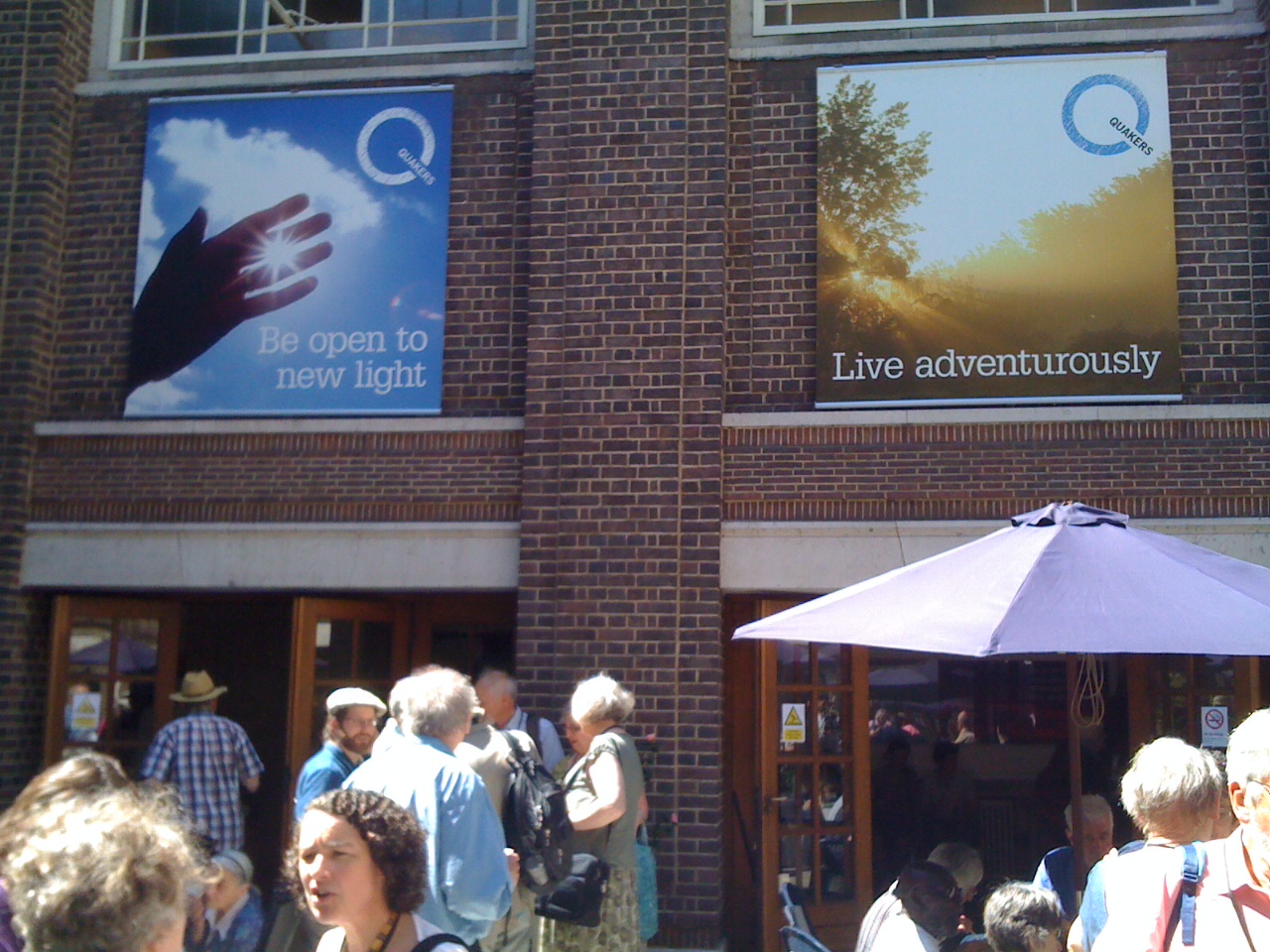
Britain Yearly Meeting have got a new badge. A Quaker Q with writing round the
edge: I’m a Quaker ask me why.
It’s an outreach effort to get Friends to ‘come out’ as
Quakers and open up conversations with people who might want to know more. I
work for the outreach team and our aim was to get everyone to leave Yearly
Meeting wearing one. So although I’m not a badge wearer I put one on.
The Yearly Meeting session on Sunday afternoon was on the
topic of ‘What it means to be a Quaker today’ and was the start of an ongoing
process that Quakers in Britain will be exploring for the next few years. The
questions behind this are important for us to explore – What does it mean for
my life to be a Quaker? What have we got to offer? How do we reach out to those
who would like to be with us but don’t know it yet? – and the introduction by
Geoffrey Durham was engaging.
He urged us to think deeply and explore adventurously. To value highly the benefits of Quaker discipline and experience and to take what we have
found out into the world positively. We have riches Friends, we have much to
offer. But the rest of the session didn’t speak to my condition. It felt to me
that people got distracted with ideas rather than speaking from their own
experience.
I left at the end of the day tired, a bit confused and
without really thinking that I was still wearing my badge. And then at the bus
stop a young woman asked me about it, asked me what it said and then challenged
me with my own question.
‘Go on then,’ she said, ‘why are you a Quaker?’
Internally I flailed slightly but managed to keep my balance.
‘Well, I guess it’s because I love being a Quaker.’
She didn’t know about Quakers, she hadn’t heard of us at all
but she wanted to talk and within her limits she was willing to listen. It turned out she’d just had a difficult
encounter with someone who said he was a Baptist and who had told her that she was
going to hell because she wasn’t saved. This was a vulnerable young woman, who
as our conversation unfolded disclosed past abuse by her father, whose eyes
filled tears when she thought about her foster mother having survived cancer
three times and who is currently out of work, behind on her rent, playing poker
for money and thinking of returning to lap dancing because the money is good.
We got on the same bus and she came to sit next to me to
continue talking. She was well turned out but had the translucent skin and
sculpted cheekbones of someone who doesn’t eat enough. She judged herself for
her ‘badness’ whilst holding out hope of a God she does believe in ‘more like a
spirit though, something inside me’.
She talked, I listened. Where I could I gently encouraged
the possibility of a loving message, of ‘that of God in everyone’ and of a
continuing process of turning towards the light. I didn’t at any point try
suggesting she should come to Quaker meeting or go into any details of what
it’s like or what I have discovered there. Not because I don’t want her to come
to one, but because I had the sense that it was more important just to be with
her, offer my listening for free with no pressure. To hold her in the light as
a precious child of God for the short time we had together.
As I got off the bus I said that it had been good to meet
her. ‘Vanessa isn’t it?’ I checked, and she nodded. I put my hand on her
shoulder. ‘I’ll remember you Vanessa,’ I found myself saying.
She’d probably be surprised how important our meeting was
for me. She brought me right to the centre of why it is that I am a Quaker. My
conversation with Vanessa didn’t just let me talk about why I’m a Quaker, it allowed
me to be more fully Quaker. Because through being a Quaker I have experienced the
transforming power of God’s love and our conversation arose from and was imbued
with that love.
If wearing a badge can help open me to opportunities to be a
more faithful Quaker then for me, that’s a badge worth wearing.
Thursday, 24 May 2012
Trusttees decide against Skyspace
I am deeply concerned that BYM trustees have decided to reject the installation of a James Turrell Skyspace as part of the Friends House, London, refurbishment.
Why are trustees making such a decision? - this is surely a matter for the whole of BYM, and I hope that it will be revisited this weekend at Yearly Meeting 2012. Trustees should be concerned with the management of our affairs, not with matters of deep spirituality. The reasons given in the minute are indeed pedestrian and managerial, and I fear for our future if these sorts of criteria are going to become the norm. Anyone with any sensibility who has visited and experienced a Skyspace should know that the light is from within - it is an utterly immersive experience, removing all boundaries of in and out.
As for the other criteria cited: read the Gospel of John, Chapter 12
Are our trustees about to betray us?
Friday, 18 May 2012
Being Salt and Light in a Broken World, a taste of the Kingdom of Heaven
Some personal reflections on being at the World Conference of Friends in Kenya
Being at the World Conference of Friends in Kenya was a
blessing and a gift. Nine days among friends, grounded in worship with plenty
of time for talking.
What’s not to like?
On the first evening I wasn’t sure if I was being called on
to be a reserve home group facilitator so I went over their training session to
find out. A group of us who had arrived on the last bus walked together along
the unlit road to the building where it was being held. Once there I discovered
that they had cover enough, so I was free to go.
I stepped out of the door,
into the dark African night, alone.
If I’m honest, I’m a bit scared of the dark. Although I knew
that the road was straight and paved, and that I knew the way back from where
we’d just come, I was afraid to walk it on my own. It was very dark without
street lighting. I thought briefly of turning back into the hall and waiting
until the session was over to return with others but pride prevented me. Also I
knew that the Friend who had shown us the way over just a few a minutes before
had set off back directly, on her own.
‘If she can do it, so can I’ I thought; a comfort and a
discipline. And so I took the hand of God and set off into the dark night, one
foot before the other, all the way home.
That campus did come to feel like home and being at home
amongst so many Friends from around the world felt like a taste of the Kingdom
of Heaven. I went to the unprogrammed early morning worship each day and from
there to breakfast and from breakfast to the plenary worship session in the
main auditorium. That’s the way to start a day. Two hours allocated worship
time before half past ten.
The mixture of the plenary worship sessions, planned and
delivered by a different ‘section’ each day, gave us the opportunity to
experience each other’s worship traditions and to hear from speakers from
different parts of the world who explored the conference theme. We heard truth
and we experienced community. Many of the speakers were younger Friends and it
was striking to hear their depth of wisdom and their confidence and ability to
preach to us.
I learned that I would like to have more preaching in my
life. I valued being given the insights of someone’s passion and thinking and
preparation and devotion. I was thankful for their willingness to make
themselves vulnerable by delivering a message to us all and I felt inspired
both by what they said and their effectiveness in saying it. I want to speak up
more about faith and learn to communicate more effectively too.
Not all the words resonated of course, and sometimes I would
have been grateful for more silence. I realised after day one that I was going
to have to take notes to have any chance of keeping hold of any of it and this
felt a bit peculiar. I generally feel very strongly that note taking during
meeting for worship is not on. There was a tendency for us to be enjoined to
take part in participation activities – to stand up or join hands or say aloud
‘we are salt and light’ – and in the main this felt awkward and self conscious
for me.
However when Jocelyn Burnell (the speaker from the Europe
and Middle Section) posed us a series of questions on being broken – ‘Are you
carrying grief or some other woundedness?’ ‘Do you feel you have failed in some
way?’ ‘Do you have a long term illness or disability?’ – and requested that if
we answered yes to any of these questions and felt able to do so we should
stand up, it changed the whole dynamic of the conference.
Everyone stood up. We are all broken. It is one of the
things that joins us together.
Through being given this opportunity to share together as a
body, I felt we, the world community of Friends, were given the space to see
that we are all the same. It was one of the
most powerful moments of the conference and once again I was required to revise
my opinion, this time on the place of ‘group participation activities’ in
worship.
Of course, singing is a commonly used group participation
activity in worship and I was prepared for that. There was much singing all
through the week and although I can feel rather left out and lonely during
singing that wasn’t my experience this time at all. I’m not a singer. I come
from an unmusical family and I never learned. So mostly I just don’t sing. I
also concur with the idea that you shouldn’t join in with singing words that
you don’t agree with just because they’re a song.
There were some instances of this during the week but also
many songs which I’d happily join in with if only I knew how. At the beginning
of one session I was sitting right up at the far back left corner of the
auditorium (two layers of raked seating up) and everyone was singing. We were
about to have Nancy Irving’s keynote address so the hall was completely full (a
quick note here to reference the work Nancy has done in bringing the Quaker
worlds together) and I realised that it would be a good idea if I took the
chance to nip to the loo.
I got up from my seat in the back row and sped down the
stairs, along the balcony, down the other stairs and across the hall, all the
while surrounded by Friends of every colour standing, singing ‘Allelu, Allelu,
Alleluiah!’ That felt like a glimpse of the Kingdom of Heaven. It did my heart
good.
That song, and the one following it, gave me plenty of time
to get back to my seat to hear Nancy’s address! She gave us thoughts on her
experience of grace, that it can come prosaically through the need to pay taxes
and that it can show God’s hand at work in our lives, if we are listening and
willing to respond.
I believe as a community we had the opportunity to
experience grace during the conference, not least through the challenges we
faced in acknowledging our differences. Such as dealing with our differing
opinions about homosexuality. I’m left troubled though by what we did with the
opportunity. As recorded elsewhere this came to light most publicly through the
matter of the epistle from North American Lesbian, Gay, Bisexual and
Transgender Friends that had been put up with the other epistles to the
conference, and was then taken down.
The public response to the epistle being taken down came from
one of the clerks of the conference organising committee. From the platform she
told the whole conference that taking this epistle down was ‘an act of hatred
and violence.’ Had she said ‘it felt like an act of hatred and violence’ I
would have had to accept that this was her experience. But to make an unfounded
emotive accusation in this way felt to me to be at best misguided and at worst
actively damaging. To one-sidedly escalate a conflict in this way seemed to me
like an abuse of power.
In my home group we had a good discussion about the matter
and we were able to hold each other’s opinions and feelings without damaging
our relationships. We heard from a Friend who said ‘Just tell me where it says
in the bible that this gay marriage is ok and then I’ll accept it’ and we heard
of the tension between the Inward Guide and the external authority and the
ongoing life of Friends’ experience of trying to balance this tension. We heard
a clear challenge to taking any authority from the story of Sodom and Gomorrah
when it advocates giving up your virgin daughter and her hand maids as an
alternative to the intentions of the Sodomites to rape a guest. None of us
agreed with rape as an acceptable practice, or of sacrificing virgins.
We heard that in Ezekiel we’re told that if you know your
friend is sinning and don’t tell him to stop that God will hold you responsible
for his sin as well as your own. And we heard that there was grave concern from
our Kenyan Friends that the epistle was up in public, on an open campus where
there were reporters present and that if word got out in Kenya that ‘Quakers
are ok with people being gay’ that it could seriously compromise the safety of
Friends and the Quaker church as a whole. It’s still illegal to be gay in
Kenya.
It struck me that we heard that taking down the epistle was
probably an act of fear and protection.
And with this understanding of the likely motives of those who
had taken it down I began to wonder about the intentions of those who had put
it up. I went to look at the epistles and the others were mainly from either
recognised constitutional groups of the Society of Friends – YMs or MMs. There
was one from American Friends Service Committee (an international organisation)
and one from a pre-conference study group (specifically formed in relation to
the conference). I query the process by which it was decided to put up an
epistle from an informal group from one country which was known in advance to
bring a contentious issue into play in a public and unfacilitated way.
When I was choosing a Thread Group to attend I was drawn to
the one on ‘Broken Sexuality’ because I knew it was an edgy topic. It was to be
facilitated by a Friend from Rocky Mountain YM (USA) and so I did some research
to find out what that meant. An American Friend told me ‘That’s a very
evangelical, politically conservative, Yearly Meeting. You’ll find they’re more
likely to want to tell you what’s right than to listen to other opinions.’ So I
signed up to enter the fray.
But then while I walked there (along that road again, this
time in the bright daytime sun) I mused on what had been said to me. ‘They’re
more likely to want to tell you what’s right than to listen to other opinions.’
It was one of those moments when a voice speaks in my ear: ‘Well, why are you
going Rosie? To give your opinion? Or are you willing to listen?’
In the event the group was facilitated with tenderness and
sensitivity. We shared from across our range of beliefs and experiences, and
the Friend from Rocky Mountain showed clearly that her only agenda was for open
and honest communication to take place. I heard some exciting messages from
African Friends – about moves towards gender equality and challenges to
damaging practices. I could see that they are doing their own work in their own
culture, in their own time and that currently homosexuality is not top of their
priority list. Which if we look back at our own history we can see it wasn’t
for us until after we’d got women sorted with the right to own their own land
either.
I was enriched by the experience of this group - I learned
from listening and offered what I could to develop the conversation through
sharing my experience. As a community we worked together to develop the
conversation and through this process we came away richer. And I made sure to
go back to the Friend I’d asked about Rocky Mountain YM to tell them that in
this case their stereotype was mistaken.
So I know it can be done -we can look beyond our stereotypes
and listen to each other. This is how we will gain strength as a community.
This is what being a community means. ‘Consider it possible you may be
mistaken.’ Friends, the key moment to consider this is exactly at the point
that you are most certain that you’re right. It’s considering this that enables
us to listen to another experience.
So one of the things that I learned at the World Conference
is that I care most passionately about how we deal with conflict, regardless of
what the issue is. I care that I’m not inadvertently part of a process that
carelessly tramples over sensitive cultural issues without thinking through
either how may feel to others or to the potential implications for individuals
within our community. That it’s of key
importance to listen and to seek to understand.
In my other Thread Group I was one of the facilitators and
it was on the theme of Quakers in Prison. We learned of different work Friends
are doing with people affected by prison. Just one example is an amazing story
of a woman who has developed work in Rwanda to promote communication and
healing between the wives of those who were killed in the genocide and the
wives of men imprisoned following it. It was a privilege and an inspiration to
share these stories.
In the dinner queue (many of the conversations of the
conference happened whilst waiting for food) I was talking with a Norwegian
Friend about which Thread Groups we were doing. On hearing of my prison theme
she told me that it was because of captured Norwegian sailors meeting Quakers
in British prisons that Quakerism came into Norway. Being amongst Friends is
rich with such moments of easy sharing of topics of interest.
The dining room was VERY NOISY. All those hundreds of
conversations in many different languages echoing round the hall. You could really
only easily hear the person sitting right next to you. In some ways it was
challenging but in others it gave a vision of determined communication. You
looked around the hall and every one was leaning forward straining to hear,
shouting to be heard. And that was my primary experience of what the conference
was like – we were all leaning towards each other to hear and be heard.
Thursday, 17 May 2012
World Conference of Friends, Kenya 2012
Sheffield Friend Chrisse Hinde attended this once-in-a-generation gathering of Quakers from around the world in Kenya last month. These are some of her reflections on the experience:
The Conference was far
more spiritually uplifting and Quaker affirming than I thought or
hoped it would be. The venue at Kabarak University was very lush and
spacious, filled with beautiful trees and flowers, giving the whole
conference a very relaxed ambience. We were about 850 Friends in
total but it didn’t feel crowded. The Kenyan Quakers (approx 400
at the conference) were very welcoming and had done some fundraising
in order for us to have a subsidised excursion day mid way through. A
Kenyan Friend remarked: ‘In Kenya we welcome visitors as
blessings’.
Each morning a
different FWCC section led the Semi-programmed worship session. The
programmed ministry from inspirational speakers around the globe was
first class and continues to uplift and challenge me as I reflect on
it. Our European and Middle Eastern section talk was by Jocelyn
Burnell who spoke of our ‘brokenness’ being a place from which
can learn a great deal and advised us not to rush to heal our pain.
She quoted Thornton Wilder: ‘In love’s service only the wounded
can serve’. Thomas Owen (Asia and West Pacific section) spoke of
how man created religion in order to know God, not vice versa, so all
religion is limited and flawed but for him Quakers offered the best
system for relationship with the Spirit and Community. Most of the
talks are available on the web site. www.saltandlight2012.org
Our home group of 15
did feel like a Quaker family. We were mixed with half Kenyan
Quakers, 3 British, an Australian and 3 North Americans. When we
started one of the Kenyan Friends pointed out that most of the white
folks were sat on one side and black folks on the other! From that
point on we made a point of mixing up each session. We talked about
our Meetings back home and our different styles of worship.
As the week progressed
we shared our experiences of other styles of worship. African Friends
from programmed Meetings had come to our early morning unprogrammed
worship, and spoke of how they encountered a deeper connection with
God in the silence. I and others shared how much the regular singing
opened us up to the spirit in a way that talking didn’t, and
through dance we could embody our praise, and prayers helped us to
focus more immediately. We were given a song book and singing formed
a regular part of our worship.
We also shared our
different views on whether it was OK to be Gay. One Kenyan Quaker
said he’d been to Pendle Hill, where he’d met Lesbian and Gay
Quakers who were more spiritual than him and they have become his
friends. He no longer had a problem with Gay Friends. One of our
ground rules in the home group was to use ‘I’ statements, as we’d
anticipated some conflict, but people were very respectful, and the
group did feel safe, grounded and a place where we could share
difference.
It’s fair to say that
as a World Gathering we didn’t achieve unity on whether it is OK to
be LGBT (Lesbian, Gay, Bisexual, Transgender). This remains a
yawning divide, but I remain convinced that it’s often the small
conversations, spoken from the heart, that make a difference. I did
find it painful when people gave anti-gay ministry quoting the Bible,
and I felt for my fellow LGBT comrades, but I appreciated people’s
honesty and willingness to stay engaged. There was a huge amount of
good will and desire for unity that was palpable, and for me made our
divisions bearable.
The visit to our
Gathering by Ex President and Kabarak Chancellor Daniel Arap Moi,
seemed to derail us, and for me felt discordant and disturbing. It
caused further division amongst us as we couldn’t find unity on how
he should be greeted, or indeed whether we should be meeting on his
land and enjoying his hospitality! I think many Kenyan’s felt hurt
by the strong objections raised. Many of them felt it necessary and
right to observe the custom of addressing him as ‘Your Excellency’
and to stand when he entered and left the auditorium. My impulse was
to do the right thing by our Kenyan hosts, but there was a strong
sense by many others that we’d really compromised our core values
as Quakers, in the way we did greet him. It was a big rupture that
left me and many others very heavy hearted.
I attended a thread
group on Broken Sexuality, which was very skillfully facilitated
(thankfully!) It gave us a chance to bring our differences on LGBT
issues to a supported setting. African Friends invited their friends
to the 2nd and 3rd session saying ‘we never
get a chance to talk about sex’. The African women in particular
wanted to talk about rape, domestic violence, polygamy and gender
inequality. It was precious to have a place we could talk openly
about these painful and difficult issues.
I also attended a
thread group on Quakers & American Civil Rights. I chose this
partly because it was co facilitated by Vanessa Julye (who wrote ‘Fit
for Freedom not for Friendship’.) It was also facilitated by Hal
Weaver (who wrote ‘Black Fire’). We covered dubious aspects of
Quaker history in which some Friends were slave owners and Klu Klux
Clan members. Also how African Americans were not permitted in many
Quaker Meetings in 1950s. I learnt about the BlackQuaker Project,
which celebrates, researches and documents achievements of Black
Quakers of African decent.
I discovered that some
North American Meetings have stopped using the term Overseer because
of its use to describe those overseeing the Slave Plantations, and
thought this a very good move. A Jamaican Friend now living in UK
spoke of how she continued to be wounded by insensitive racist
remarks from well meaning Friends and had often considered leaving,
but chose to stay. This continues to prod me into thinking we need to
do more to welcome our wonderfully diverse community in Sheffield
into our Meeting.
The party on the last
night of the Gathering was a truly amazing occasion. Kenyan musicians
blasted out funky dance tunes causing a huge body of Quakers to get
to their feet and, strut, sway and gyrate themselves around the
auditorium in crocodile formation. Young and old, gay and straight,
black and white Friends united in joyful celebration. It’s an
image and a memory I will treasure for the rest of my days. A perfect
finale to this wonderful event. I feel hugely blessed to be part of a
world family of Quakers and to have met Friends from the far reaches
of our planet. Asante sana FWCC!
Subscribe to:
Posts (Atom)


